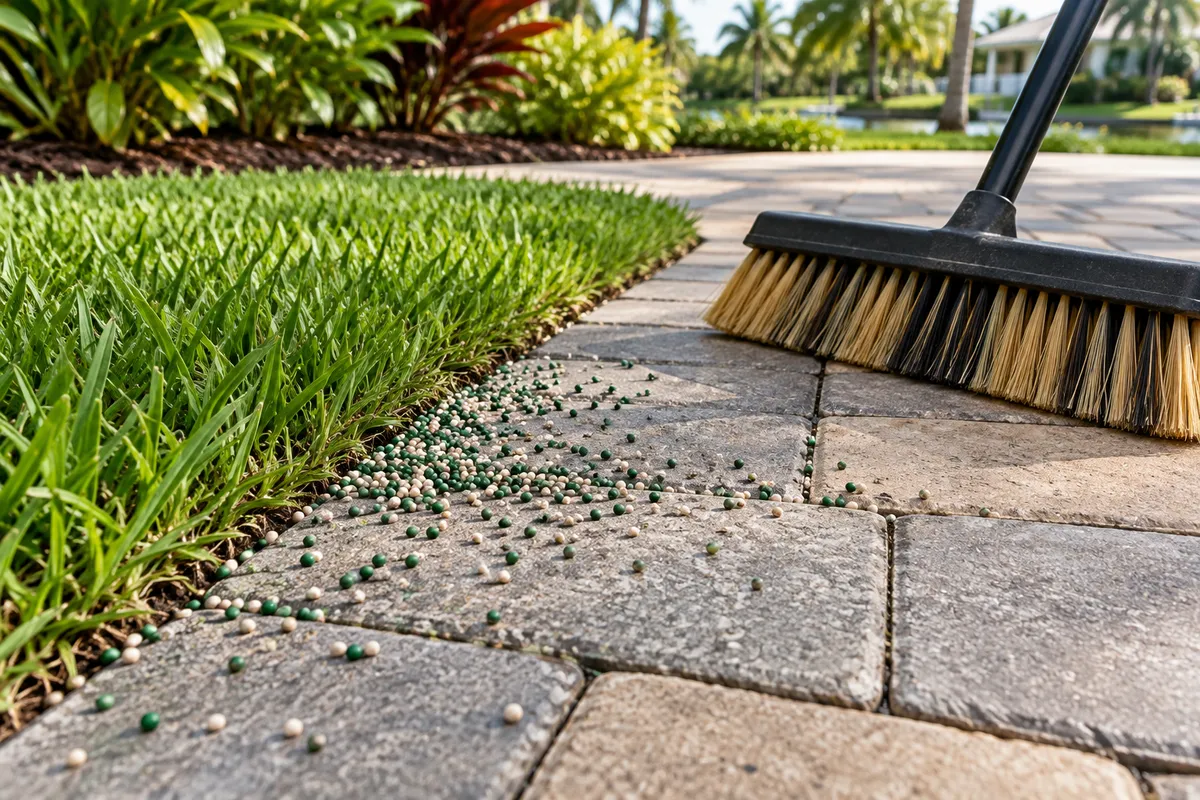
Fertilizer Granules on Pavers: Prevent Orange Spots
Small orange spots near a lawn edge can come from fertilizer granules left on the pavement. Products containing iron are one possible source. The location and timing provide clues, but color alone is not enough to choose a cleaner: irrigation rust, metal objects and other contamination can look similar.
For the wider maintenance process, see our paver restoration and failed-sealer guide.
Check the landscape work history
Ask which fertilizer was used and when it was applied. Look for scattered spots near the spreader's turning area, driveway border or planting beds. Compare the pattern with sprinkler coverage and nearby metal. Save the product label so the maintenance provider can distinguish fertilizer exposure from a broader irrigation-water problem.
Sweep before water reaches the pellets
Keep fertilizer on the intended landscape area. After spreading, remove granules from the pavement according to the product's directions before irrigation or rain wets them. Do not blow them into a pool or storm drain. Washing pellets across the driveway can spread the exposure instead of eliminating it.
Treat the surface as a system
Determine whether the area is concrete, clay or natural stone and whether it has a coating. A remover that is appropriate for one surface may discolor or etch another. Test the selected product and follow its label. Avoid household acid mixtures and unverified online recipes, particularly on travertine, marble or limestone.
Know when a stain is not just a stain
An orange spot may be removable contamination, but harsh previous treatment may have altered the surface around it. A lighter halo or roughened area can indicate damage that cleaning alone will not reverse. Evaluate the dry result in ordinary light before repeating treatment. Stronger chemistry is not necessarily a better second attempt.
Coordinate prevention with lawn care
Tell the landscape provider that pavement protection is part of the maintenance routine. Ask for cleanup after spreading and controlled irrigation afterward. Before a sealing project, resolve active sources so new marks do not appear immediately after application. Sealer can reduce absorption when compatible, but it is not a substitute for keeping fertilizer off the pavers.
Frequently asked questions
Do all fertilizers stain pavers?
No. Composition and contact conditions vary; check the actual product label and exposure history.
Will sealing guarantee no fertilizer stains?
No. Sealer performance varies, and granules should still be removed promptly.
Related care guides
Discuss your paver project
Restore Paver Company can evaluate cleaning, sanding, sealing and restoration needs for your property. Request a free quote or call (813) 235-2551. Share photographs, the surface material and any known coating or treatment history.
Further reading
General material-care references; product instructions and the condition of the actual installation control the final treatment.
