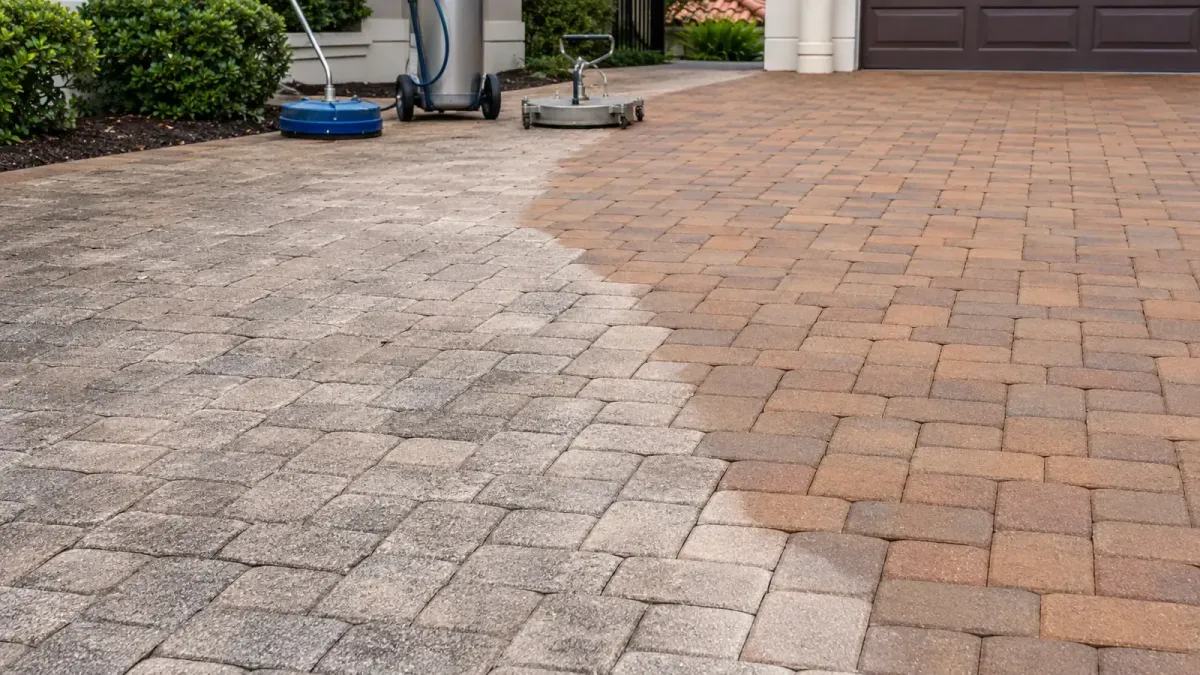
Paver Restoration and Failed Sealer Repair in Tampa
Quick answer: Paver restoration starts with diagnosis. White deposits may be surface efflorescence or moisture trapped beneath a coating. Peeling can fail at the paver, between coating layers or inside an old weak film. Sticky areas may be uncured material, excessive film, contamination or incompatible chemistry. The repair must match the failure depth; cleaning, a maintenance coat, localized correction and full stripping are not interchangeable.
Key takeaways
- Do not coat over a symptom until the layer that failed is identified.
- A new sealer bonds only as well as the surface and coating beneath it.
- Stains require type-specific treatment before color enhancement or clear film.
- Correct irrigation, drainage and moisture contributors before rebuilding the finish.
- Prove the repair in a small area before committing the full property.
How this guide was prepared
This guide combines Restore Paver Company’s Tampa Bay field-evaluation process with current hardscape-industry maintenance guidance and manufacturer technical requirements. Product requirements vary; the exact surface, coating history and current data sheet control the final scope.
Restoration is different from routine cleaning
Routine cleaning removes soil, algae and surface contamination from a stable pavement. Restoration addresses coating failure, staining, lost joints, uneven color, repairs or conditions that prevent a new system from bonding and curing evenly.
A driveway may look dull because it needs cleaning, because the old film has worn, because moisture has turned it cloudy or because repeated topcoats trapped contamination. Those conditions can look similar from the street but require different work.
Start with a failure map
Walk the entire surface and mark patterns. White areas around sprinklers or low spots point toward moisture or mineral exposure. Tire-lane peeling suggests traffic and bond stress. Sticky protected edges can indicate excess film that never wore away. Random bubbles after a hot application can point to rapid surface skinning or vapor.
- Photograph sun, shade, edge, center, tire path and irrigation zones.
- Record when the coating was applied and what product was used, if known.
- Check whether the defect is above, within or beneath the clear film.
- Inspect drainage, joint depth, paver movement and old repairs.
- Note cleaners, pressure washing or maintenance coatings applied afterward.
Common symptoms and the questions they raise
| Symptom | Possible mechanism | What to verify |
|---|---|---|
| White or cloudy film | Trapped moisture, blush, incompatible layer or salts | Is the whitening on top or under a coating? |
| Peeling or flaking | Contamination, weak old film or poor compatibility | At which interface does the coating release? |
| Bubbles or blisters | Moisture vapor, heat, heavy film or trapped carrier | Weather, paver temperature, coverage and moisture |
| Sticky or soft areas | Excess material, cure problem, incompatible recoat or mix error | Product, coat thickness, mix ratio and elapsed time |
| Dark uneven patches | Absorption differences, stain or old coating buildup | Does cleaning or a solvent test change the area? |
| Recurring edge failure | Irrigation, standing water, runoff or weak joints | What environmental source repeats at that location? |
White haze and efflorescence need different treatment
Efflorescence is a salt deposit at the surface. Coating haze is whitening in or beneath a film. Acidic efflorescence cleaners can damage acid-sensitive stone and may not correct trapped coating moisture. Adding solvent or another coat without confirming chemistry can worsen failure.
Use the white haze vs efflorescence guide to identify location, texture and test results before choosing a cleaner or coating repair.
When cleaning and maintenance may be enough
A sound, compatible coating that is evenly worn can often be cleaned, prepared and maintained according to manufacturer instructions. The surface should not be peeling, sticky, milky, contaminated or excessively built up. Joints and drainage should also be stable.
“Compatible” is not permission to spray over dirt. Preparation still controls bond. Representative testing should include the worst reasonable area, not only a protected sample near the garage.
When localized correction makes sense
A contained defect from a spill, isolated sprinkler leak or small application error may be repairable when the surrounding system is sound. The correction must blend in color and sheen, and the test should show that the repair does not soften or lift adjacent coating.
Localized work is less suitable when failure is widespread, moisture sources repeat across the property or several unknown coating layers exist. Those conditions point toward system-level restoration.
When stripping is the responsible scope
Strip when the old film is not a dependable foundation: widespread peeling, trapped whitening, persistent tack, heavy uneven buildup, incompatible chemistry or contamination within the coating. Removal products and mechanical methods should be tested for the specific film and paver.
Professional stripping includes protection, controlled dwell, agitation, recovery or containment as appropriate, repeated passes for heavy layers, thorough rinsing, joint restoration and sufficient preparation for the replacement system. Read the failed-sealer repair and stripping guide before accepting a proposal that treats stripping as one quick wash.
Stain removal belongs before sealing
Oil, irrigation rust, tannin, organic growth and paint respond to different cleaners. Color-enhancing clear film can make residual stains more prominent and harder to reach. The goal may be removal, reduction or honest disclosure when a stain has penetrated beyond practical correction.
The paver stain-removal guide explains stain-specific testing and why natural stone needs extra chemical caution.
Rebuild the surface as a compatible system
- Correct water sources, drainage and repairs.
- Remove failed film and contaminants to the required degree.
- Restore joints with a compatible material and process.
- Allow the surface to meet moisture and weather requirements.
- Approve a cured color-and-sheen sample.
- Apply measured coverage and protect the cure.
- Document maintenance so the same buildup is not repeated.
The replacement coating should be selected after the surface is understood. Use the sealer chemistry guide and finish guide as separate decisions.
What a restoration estimate should say
Require a defined test area, assumed number of coating layers, included removal passes, stain allowances, runoff protection, joint-sand replacement, coating system, finish, coverage, exclusions and how unforeseen layers will be handled. A fixed price with no stated assumptions can hide a large scope gap.
Restore Paver Company can inspect the surface and prepare a project-specific plan. Review paver restoration services and completed project examples, then request a free evaluation or call (813) 235-2551.
Frequently asked questions
Can failed paver sealer be fixed without stripping?
Sometimes. Sound surrounding film and a contained defect may allow a localized or manufacturer-approved correction. Widespread adhesion, moisture or buildup problems usually require more removal.
Will pressure washing remove old sealer?
Pressure alone rarely removes a coating evenly. Excessive force can scar pavers and empty joints while leaving bonded film in patches.
Can another coat hide white haze?
It may temporarily change appearance, but it can also trap moisture or amplify incompatibility. Diagnose whether the white condition is on top of or beneath the coating first.
How long does paver sealer stripping take?
Coating chemistry, number of layers, area, temperature, access and containment determine time. Heavy multilayer systems can require repeated cycles.
Will restored pavers look brand new?
Restoration can greatly improve appearance, but permanent stains, mixed paver lots, repairs, wear and material variation may remain. A test area sets an honest expectation.
Related paver guides
- Paver Sealer Turned White? Haze vs Efflorescence
- Failed Paver Sealer: Repair It or Strip It?
- How to Remove Paver Stains Before Sealing
- Paver Sealing in Tampa Bay: The Complete Homeowner Guide
- Water-Based vs Solvent-Based vs Urethane Paver Sealer
- Paver Sealer Dry Time, Cure Time and Rain in Florida
Request a Tampa Bay paver evaluation
Restore Paver Company provides paver cleaning, joint sanding, sealing, failed-sealer repair and natural-stone care. Review our paver restoration services, see the project gallery, or request a free quote. You can also call (813) 235-2551.
Technical references
Installation requirements vary by material and product. Always follow the current label and technical data sheet for the exact cleaner, joint material and sealer used.
- Concrete Masonry & Hardscapes Association — PAV-TEC-005: Cleaning, Sealing and Joint Sand Stabilization
- Concrete Masonry & Hardscapes Association — PAV-TEC-006: Operation and Maintenance Guide
- Belgard — Hardscape Maintenance and Care Guide
- Techniseal — WL-87 Joint-Stabilizing Sealer Technical Data Sheet
