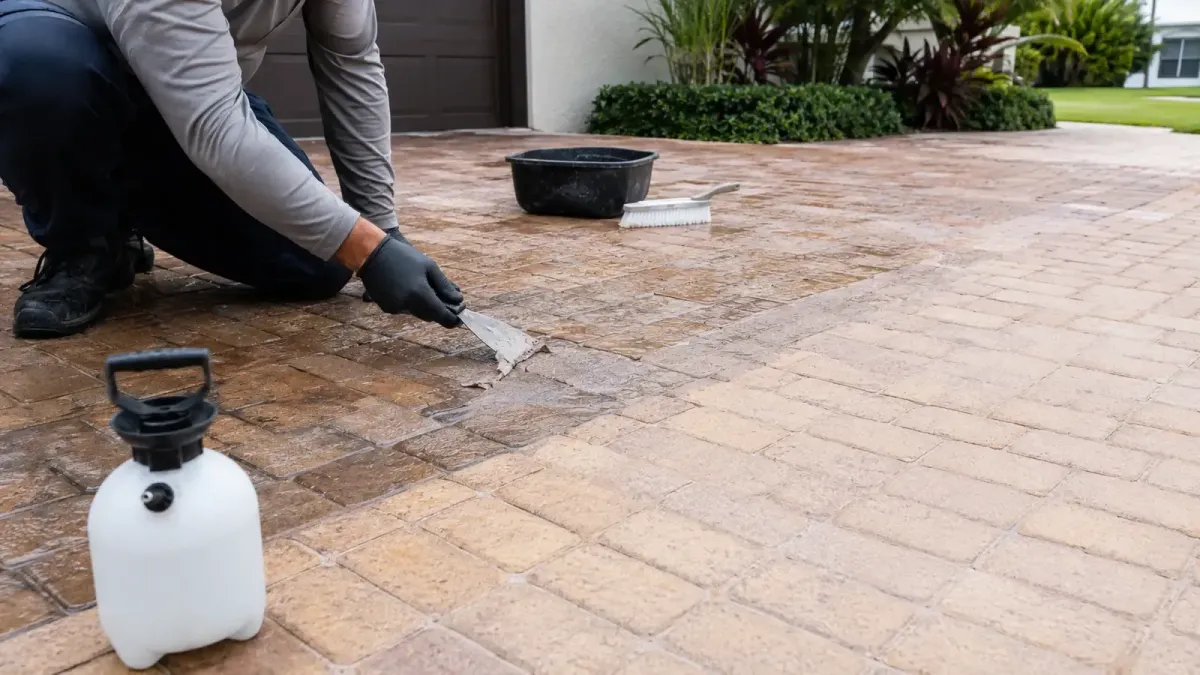
Failed Paver Sealer: Repair It or Strip It?
Quick answer: Repair is reasonable when the defect is isolated, the surrounding coating is sound and a tested correction blends and bonds. Strip when failure is widespread, the old film releases, whitening is trapped, the surface stays sticky, buildup is heavy or the next coating is incompatible. Another coat is not a repair if the layer beneath it cannot support the new film.
Key takeaways
- Find the failed interface: paver-to-coating, old-to-new coating or within a soft layer.
- Pressure washing is not a substitute for uniform coating removal.
- Stripping estimates should state assumptions about layers and repeated passes.
- Joint sand and drainage usually need attention after removal.
Symptom does not equal cause
Peeling may begin with contamination, moisture, weak old sealer or incompatible chemistry. Bubbles can follow hot application, vapor pressure, heavy film or trapped carrier. Sticky coating may be overapplied, improperly mixed, incompletely cured or softened by a later product. The repair must address the mechanism.
Record coating history, weather, cleaning, mix information and when the defect appeared. Patterns across sun, shade, edges and tire lanes help narrow the cause.
Use adhesion and compatibility evidence
Small tests can show whether the old film is bonded, whether the proposed cleaner or coating softens it and whether a repair develops the expected appearance. Follow the coating manufacturer’s method; an improvised aggressive scrape can damage the paver and produce misleading results.
Test more than the best area. Include a representative failure zone, sprinkler edge and traffic lane when safe.
Decision table: maintain, repair or strip
| Observed condition | Likely direction | Reason |
|---|---|---|
| Sound, compatible, evenly worn film | Clean, prepare and maintain | The existing layer remains a dependable base |
| Small isolated defect; surrounding film sound | Test localized correction | Contained work may solve the cause without full removal |
| Widespread peeling or delamination | Strip failed system | New film would release with the old layer |
| Persistent tack or heavy buildup | Remove unstable excess | More coating increases film stress and dirt pickup |
| Trapped white haze across many areas | Diagnose moisture; often remove affected film | Topcoating can seal in the defect |
| Unknown multilayer coating with inconsistent tests | Expand testing; price restoration assumptions | Compatibility cannot be proven from one spot |
What professional stripping actually includes
- Protect walls, doors, vegetation, pool water and drainage paths.
- Test the removal method on the specific coating and paver.
- Apply controlled dwell and agitation without allowing material to dry where prohibited.
- Remove softened film and residue with appropriate containment.
- Repeat as needed for multiple layers.
- Clean and inspect the exposed paver.
- Restore disturbed joints and correct water sources.
- Prepare and test the replacement system.
A heavy coating may not disappear in one pass. The proposal should explain how additional layers or unexpected chemistry affect cost.
Why pressure alone creates a patchy result
High pressure removes loose film first and leaves better-bonded sections behind. It can gouge paver faces, open joints and drive water under edges before the coating is uniformly removed. That patchwork absorbs new sealer differently and can create obvious color and gloss variation.
Use pressure as one controlled part of a tested removal process, not as the only specification.
Rebuilding after removal
Once film is removed, remaining stains and color variation become visible. Treat stains before sealing, allow the surface to meet moisture requirements and choose a compatible joint and coating system. The stain-removal guide and sealer chemistry guide support those decisions.
Approve a cured sample. Newly exposed pavers may absorb differently from areas that retained trace coating, so the test should represent the restored surface.
Questions to ask about a stripping estimate
- What coating and number of layers are assumed?
- How large is the test area and what will it prove?
- How are walls, pool water, plants and runoff protected?
- How many removal cycles are included?
- Is joint-sand replacement included?
- What condition is excluded as permanent discoloration or paver damage?
- Which replacement coating and measured coverage are proposed?
Use the cost and scope guide to compare the full restoration, not only a price per square foot.
Frequently asked questions
Does every resealing job require stripping?
No. A sound, compatible and evenly worn coating may be suitable for cleaning, preparation and maintenance.
Can solvent fix cloudy paver sealer?
Some manufacturers permit chemistry-specific blush correction, but the wrong solvent can soften, smear or damage a coating. Identify the product and test first.
Can I put water-based sealer over solvent-based sealer?
Carrier labels alone do not prove compatibility. The cured resins, old-film condition and manufacturer guidance determine whether a recoat is possible.
Will stripping damage pavers?
Poor methods can. Professional testing, controlled chemistry, pressure and dwell reduce risk, but pre-existing discoloration or damage may become more visible after film removal.
Related paver guides
- Paver Restoration and Failed Sealer Repair in Tampa
- Paver Sealer Turned White? Haze vs Efflorescence
- How to Remove Paver Stains Before Sealing
- Water-Based vs Solvent-Based vs Urethane Paver Sealer
- Paver Sealer Dry Time, Cure Time and Rain in Florida
- Paver Sealing Cost and Value in Tampa: 2026 Guide
Request a Tampa Bay paver evaluation
Restore Paver Company provides paver cleaning, joint sanding, sealing, failed-sealer repair and natural-stone care. Review our paver restoration services, see the project gallery, or request a free quote. You can also call (813) 235-2551.
Technical references
Installation requirements vary by material and product. Always follow the current label and technical data sheet for the exact cleaner, joint material and sealer used.
