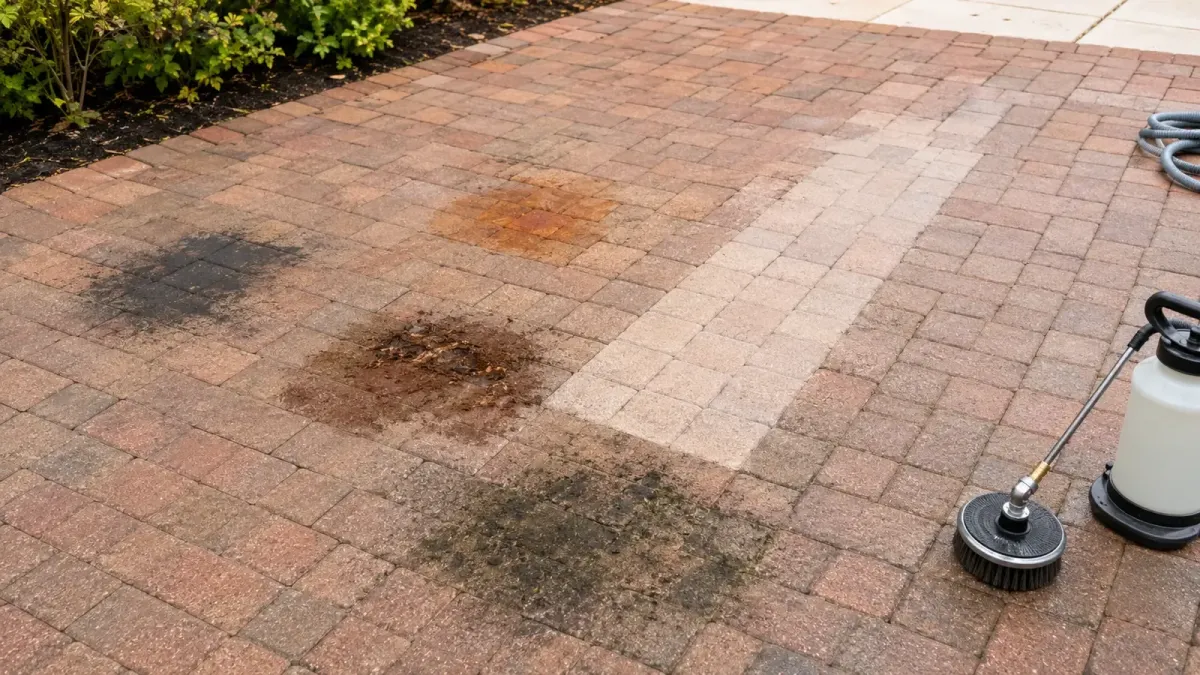
How to Remove Paver Stains Before Sealing
Quick answer: Identify the stain before selecting a cleaner. Oil needs extraction or degreasing, irrigation rust requires iron-specific treatment, leaf tannin and biological growth use different chemistry, and efflorescence is a salt deposit rather than dirt. Remove or reduce stains before clear or color-enhancing sealer makes them harder to reach and potentially more visible.
Key takeaways
- Use the least aggressive effective method and test first.
- Do not mix cleaners or assume a product safe for concrete is safe for natural stone.
- Rinse and neutralize only as the label directs, then meet the sealer’s moisture requirement.
- Set realistic expectations for deep oil, battery acid, paint and permanent mineral damage.
Diagnose by source, color, location and behavior
A black spot in a parking area may be motor oil, tire residue or organic growth. Orange streaks below sprinkler heads suggest iron-bearing water. Brown shadows under oak leaves point toward tannins. White deposits can be efflorescence, hard-water scale or coating haze.
Ask when the stain appeared, what has already been applied and whether the surface is concrete paver, clay brick or natural stone. Photographs and a small wet test can help, but chemistry should be proven in an inconspicuous area.
Stain-specific planning
| Stain type | Typical approach | Main caution |
|---|---|---|
| Oil and grease | Absorb fresh material; use compatible degreaser or poultice | Deep oil may wick back as the surface dries |
| Irrigation rust | Iron-specific cleaner approved for the surface | Acids can alter concrete color and etch calcite stone |
| Leaf tannin | Organic-stain cleaner and controlled dwell | Sealing over a shadow can deepen its appearance |
| Algae or mildew | Biological cleaner plus correction of shade/water source | Growth returns if damp conditions remain |
| Efflorescence | Dry removal and approved mineral-deposit cleaner when needed | Do not confuse it with coating haze |
| Paint or coating spill | Material-specific remover and test | Solvent can spread residue or attack old sealer |
Why sealing does not hide stains reliably
Clear sealer follows the color beneath it. Wet-look and enhancing products often deepen contrast, which can make residual oil, rust and tannin more noticeable. Film may also reduce the cleaner’s ability to reach a stain later.
Judge the dry cleaned surface and, when appropriate, preview color enhancement with a compatible test method. Approve any permanent shadow before full application.
Protect the paver and surrounding property
- Read the cleaner label and safety data before use.
- Protect skin, eyes, metals, glass, paint, landscaping and pool water.
- Do not let test chemistry enter storm drains or water bodies.
- Do not mix bleach, ammonia, acids or other cleaners.
- Control pressure so softened stain is removed without scarring the face.
- Rinse or neutralize exactly as required, not by guesswork.
Natural stone changes the chemical rules
Travertine, limestone and marble contain calcite and can etch when exposed to acids. A cleaner that removes rust or mineral deposits from concrete brick may permanently dull or roughen those stones. Use stone-industry guidance and stone-safe products.
The travertine and natural-stone guide explains penetrating sealers, acid sensitivity and pool-deck considerations. The Natural Stone Institute also recommends stain-specific methods rather than one universal cleaner.
A professional pre-seal sequence
- Identify the surface and stain source.
- Stop ongoing oil, irrigation or drainage exposure.
- Test cleaner strength, dwell and agitation.
- Treat from least aggressive to more specialized as needed.
- Rinse, extract or neutralize according to the label.
- Allow the surface to dry and watch for oil wick-back.
- Document permanent shadows or damage.
- Approve the coating sample only after the stain work is complete.
Frequently asked questions
Will pressure washing remove oil from pavers?
It may remove surface soil but can spread or drive oil deeper. Degreasing or poultice methods are often needed, followed by controlled rinsing.
Can irrigation rust come back after sealing?
Yes, if iron-bearing overspray continues. Correct the sprinkler source; sealer is not a substitute for water management.
Can chlorine clean pavers before sealing?
Some biological cleaners contain hypochlorite, but concentration, surface compatibility, metals, plants, runoff and complete rinsing matter. Natural stone may require a different method.
What if a stain cannot be fully removed?
Set the expectation with a dried test area. Replacement pavers, tinting or accepting a reduced shadow may be more responsible than aggressive damage.
Related paver guides
- Paver Restoration and Failed Sealer Repair in Tampa
- Paver Sealer Turned White? Haze vs Efflorescence
- Failed Paver Sealer: Repair It or Strip It?
- Paver Sealing in Tampa Bay: The Complete Homeowner Guide
- Travertine and Natural Stone Sealing in Florida
Request a Tampa Bay paver evaluation
Restore Paver Company provides paver cleaning, joint sanding, sealing, failed-sealer repair and natural-stone care. Review our paver restoration services, see the project gallery, or request a free quote. You can also call (813) 235-2551.
Technical references
Installation requirements vary by material and product. Always follow the current label and technical data sheet for the exact cleaner, joint material and sealer used.
