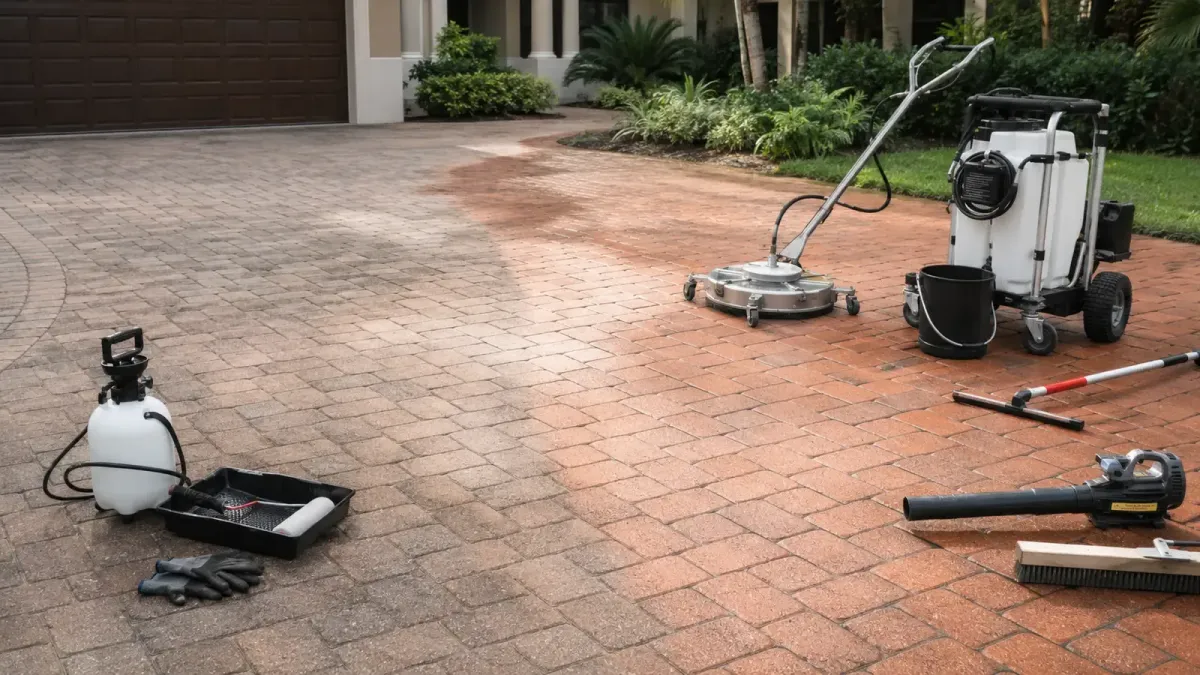
DIY vs Professional Paver Sealing in Florida
Quick answer: A careful homeowner may maintain a small, sound, uncoated or well-documented surface when the cleaner, joint material and sealer instructions are clear and weather is stable. Hire a professional when old coating is unknown or failing, stains are significant, joints or drainage need repair, the surface is natural stone, or the project is too large to clean, sand and coat within the approved window.
Key takeaways
- The hardest DIY task is diagnosis, not operating a roller.
- Equipment and material cost should include protection, testing and correction risk.
- Large areas magnify wet-edge, coverage and weather problems.
- A contractor should still explain the exact system and scope.
Projects a careful homeowner may handle
- Small patio or walkway with sound, uncoated concrete pavers
- Known compatible maintenance system with no haze, peeling or buildup
- Minor routine cleaning without deep stains or unstable joints
- Clear manufacturer instructions that match the surface and climate
- Enough time, help and weather to complete preparation and coating correctly
Begin with a test area and stop if color, absorption or coating behavior is unexpected.
Conditions that justify a restoration contractor
- White, cloudy, peeling, sticky or bubbled coating
- Unknown multilayer sealer or incompatible patch repairs
- Deep oil, rust, paint or mineral staining
- Travertine, marble, limestone or mixed materials
- Large driveway requiring a continuous wet edge
- Pool-water protection, difficult runoff or screen enclosure
- Rocking pavers, settlement, edge failure or repeated sand washout
- Two-component coating with exact ratio and limited pot life
The failed-sealer hub explains why another coat is not a safe DIY experiment over an unsound film.
True DIY cost checklist
| Cost group | Examples |
|---|---|
| Diagnosis and testing | Moisture, coating compatibility, sample materials |
| Cleaning | Surface cleaner, pressure washer, stain-specific chemicals, extraction |
| Joint work | Removal, sand, compaction, dust control |
| Application | Compatible sprayer, rollers, mixing tools, measuring containers |
| Protection | Plastic, tape, barriers, pool and landscape protection |
| Safety | Gloves, eye protection, respirator when required, footwear |
| Time and correction | Multiple workdays, weather delays, extra product, failed test removal |
Common DIY failure points
Cleaning at excessive pressure scars pavers and empties joints. Sand residue left on the face becomes locked under clear film. Coating applied too heavily puddles in joints and low areas. Starting late in the day can push the second coat into dew or rain. Guessing a two-part ratio can leave material soft. Rolling back into partially set coating creates lap marks.
Read the Florida weather and cure guide and sealer chemistry guide before buying material.
How to compare a professional proposal with DIY
Remove items the contractor is not actually providing, then compare the same scope: measured area, stain treatment, joint depth, sand, exact sealer, applications, property protection, cure instructions, warranty and correction responsibility.
The contractor’s value should include diagnosis, equipment, scheduling and accountability—not only labor. Use the company and estimate comparison guide to verify that value.
A responsible DIY decision rule
Proceed only when you can identify the surface and coating, correct preparation is within your equipment and experience, the manufacturer supports the system, and the project can be completed within the weather window. If any of those answers is uncertain, pay for inspection before paying for materials.
For a professional evaluation, request a free quote from Restore Paver Company or call (813) 235-2551.
Frequently asked questions
Is DIY paver sealing cheaper?
It can reduce labor cost on a simple sound surface, but equipment, materials, time and correction risk must be included. Failed coating removal can exceed the initial savings.
Can I use a garden sprayer for paver sealer?
Only if the sprayer manufacturer and sealer instructions confirm chemical compatibility, seals, pressure and spray pattern. Solvent products and high-solids coatings may require specialized equipment.
Can one person seal a large driveway?
Maintaining coverage and a wet edge across a large area can be difficult, especially in heat and wind. Crew size should fit the product working time.
Should DIY pavers be sanded before sealing?
If joints are low or unstable, they may need full-depth preparation and compatible sand. Do not sweep a cosmetic top layer over contamination.
Related paver guides
- Paver Sealing Cost and Value in Tampa: 2026 Guide
- How to Choose a Paver Sealing Company in Tampa
- Paver Sealing in Tampa Bay: The Complete Homeowner Guide
- Water-Based vs Solvent-Based vs Urethane Paver Sealer
- Paver Sealer Dry Time, Cure Time and Rain in Florida
- Paver Restoration and Failed Sealer Repair in Tampa
Request a Tampa Bay paver evaluation
Restore Paver Company provides paver cleaning, joint sanding, sealing, failed-sealer repair and natural-stone care. Review our paver restoration services, see the project gallery, or request a free quote. You can also call (813) 235-2551.
Technical references
Installation requirements vary by material and product. Always follow the current label and technical data sheet for the exact cleaner, joint material and sealer used.
- Concrete Masonry & Hardscapes Association — PAV-TEC-005: Cleaning, Sealing and Joint Sand Stabilization
- Concrete Masonry & Hardscapes Association — PAV-TEC-006: Operation and Maintenance Guide
- Belgard — Hardscape Maintenance and Care Guide
- Techniseal — WL-87 Joint-Stabilizing Sealer Technical Data Sheet
