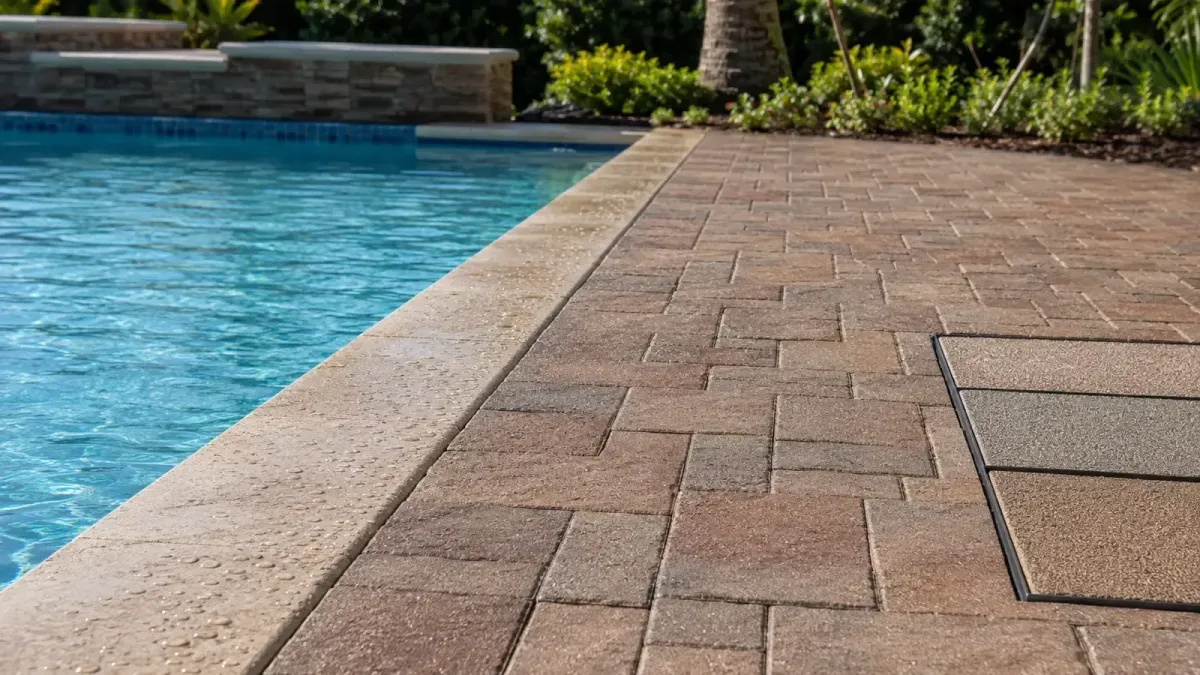
Do Sealed Pavers Get Slippery Around a Pool?
Quick answer: Sealed pavers can feel more slippery when a coating reduces surface texture, film is applied too heavily, the finish is glossy, or water, algae and sunscreen are present. A properly selected and applied system can preserve or add useful texture, but no wet exterior surface is slip-proof. Test the cured system and maintain the deck.
Key takeaways
- Product name alone does not predict wet traction.
- Texture, coating thickness and contamination interact.
- Traction additive must be compatible, evenly distributed and comfortable for bare feet.
- Drainage and routine cleaning matter after the coating cures.
What changes traction
| Factor | Potential effect | What to evaluate |
|---|---|---|
| Original paver texture | Rougher profiles can preserve more microtexture | Worn, tumbled, smooth or dense face |
| Film thickness | Heavy coating can bridge surface texture | Measured coverage and puddling |
| Gloss level | Often correlates with visible film but is not a test result | Cured wet sample on actual paver |
| Water and drainage | Standing water changes contact with the surface | Slope, deck drains and low spots |
| Algae and sunscreen | Creates a lubricating layer over any finish | Cleaning frequency and shaded zones |
| Traction additive | Adds microtexture to compatible film | Particle size, loading, distribution and comfort |
Wet look is not the same as slippery
Wet look refers to deeper paver color. A wet-look system can have low, satin or high sheen. Slip potential depends on the cured coating, film build and surface conditions, not the marketing phrase.
Use the natural, wet-look and high-gloss guide to approve appearance separately from traction. Do not choose a high-build finish and assume additive will solve every surface issue.
How traction additive works
Fine compatible particles remain in or near the coating surface and create microtexture. The additive must stay suspended or be redistributed so it does not settle in one area. Application technique, re-rolling and coat placement affect uniformity.
Too little may have limited effect. Too much can cloud a clear finish, create uneven feel, hold soil or be uncomfortable under bare feet. Follow the coating manufacturer’s approved additive and rate.
A better pool-deck test
- Clean the representative area and remove algae, oil and old residue.
- Confirm existing coating compatibility.
- Apply the proposed system at measured coverage, including additive when specified.
- Allow the sample to fully cure under the stated conditions.
- Review color, sheen and barefoot comfort.
- Evaluate the surface wet under controlled safe conditions.
- Document maintenance needed to preserve the result.
A small visual sample that is still uncured or never wetted does not answer the pool-deck question.
Why decks become slippery months later
Algae grows in shaded damp areas, sunscreen and body oils accumulate near entries, and soil fills microtexture. Repeated maintenance coats can also create thicker film in protected zones. Drainage changes or irrigation may keep edges wet.
Clean and diagnose before recoating. The resealing guide explains why loss of gloss or traction should not automatically trigger another layer.
Surface selection matters
Penetrating products generally leave less surface film and may preserve original texture, but they do not automatically provide the color enhancement or joint stabilization of a film-forming system. Natural stone has its own porosity and acid sensitivity.
Use the pool-deck and natural-stone hub for the complete material decision and travertine sealing guide for calcite stone.
Frequently asked questions
Does high-gloss sealer make pavers slippery?
It can reduce texture when film build is heavy, but actual slip potential also depends on paver texture, water, contamination and additive. Test the installed system.
Can sand be mixed into paver sealer for traction?
Use only an additive approved by the coating manufacturer. Play sand or unknown aggregate can settle, cloud the finish and create inconsistent texture.
Is a penetrating sealer non-slip?
It may preserve more original texture because it creates little film, but no product makes a wet exterior surface slip-proof.
How often should a sealed pool deck be cleaned?
Clean often enough to prevent algae, sunscreen and soil buildup. Frequency depends on shade, pool use, irrigation and surrounding vegetation.
Related paver guides
- Pool Deck and Natural Stone Sealing in Tampa
- Travertine and Natural Stone Sealing in Florida
- Natural Look vs Wet Look vs High Gloss Paver Sealer
- Water-Based vs Solvent-Based vs Urethane Paver Sealer
- Paver Sealer Dry Time, Cure Time and Rain in Florida
- How Often Should Pavers Be Resealed in Tampa Bay?
Request a Tampa Bay paver evaluation
Restore Paver Company provides paver cleaning, joint sanding, sealing, failed-sealer repair and natural-stone care. Review our paver restoration services, see the project gallery, or request a free quote. You can also call (813) 235-2551.
Technical references
Installation requirements vary by material and product. Always follow the current label and technical data sheet for the exact cleaner, joint material and sealer used.
- Concrete Masonry & Hardscapes Association — PAV-TEC-005: Cleaning, Sealing and Joint Sand Stabilization
- Concrete Masonry & Hardscapes Association — PAV-TEC-006: Operation and Maintenance Guide
- Natural Stone Institute — ASTM Standards Relevant to Natural Stone
- Techniseal — WL-87 Joint-Stabilizing Sealer Technical Data Sheet
